Microsoft Azure Synapse Analytics is a next-generation data integration and analytics service that unifies enterprise data warehousing, big data analytics, and machine learning. By combining data ingestion, preparation, storage, and insights into a single platform, Synapse makes it possible to accelerate business intelligence and deliver predictive insights at scale.
Key Features
- Synapse SQL – Query data using provisioned (dedicated) or on-demand (serverless) resources. Run high-performance SQL queries on both structured and semi-structured data.
- Apache Spark Pools – Natively integrated Spark clusters for advanced data processing, ETL, and machine learning.
- Data Pipelines – Orchestrate ingestion, transformation, and movement of data across sources, leveraging built-in Azure Data Factory capabilities.
- Data Explorer Integration – Support for log and time-series analytics for real-time insights.
- Unified Workspace – Synapse Studio provides a web-based environment where engineers, analysts, and scientists collaborate on data.
- Deep Azure Integration – Seamless connectivity with Power BI, Azure Data Lake Storage, Cosmos DB, and Azure Machine Learning.
- Enterprise Security & Governance – Row- and column-level security, dynamic data masking, auditing, and encryption backed by Azure Active Directory integration.
Business Benefits
- Accelerated Insights – Reduce the time from raw data to actionable intelligence.
- Scalability & Flexibility – Scale compute resources up or down, or use serverless queries to control costs.
- Unified Platform – Eliminate the need for multiple disconnected tools for analytics, storage, and ETL.
- Cost Efficiency – Pay for only what you use, or reserve dedicated resources for predictable workloads.
- Diverse Data Support – Analyze structured, semi-structured, unstructured, and streaming data in one platform.
- Advanced Security – Protect sensitive data with enterprise-grade compliance and governance tools.
If you're evaluating Azure Synapse for your analytics or data warehousing needs, contact our team to discuss your goals.
Use Cases
- Real-Time Analytics – Process IoT streams, logs, and telemetry data for faster decision-making.
- Business Intelligence – Create reports and dashboards by integrating Synapse with Power BI.
- Predictive Analytics – Build and score machine learning models directly inside Synapse.
- Unified Data Lakehouse – Store raw data and curated analytics within a single environment.
- Industry Applications:
- Retail: Personalization, demand forecasting, inventory optimization.
- Healthcare: Patient analytics, operational efficiency, predictive care.
- Finance: Fraud detection, compliance reporting, risk modeling.
- Manufacturing: Predictive maintenance, supply chain visibility.
Getting Started
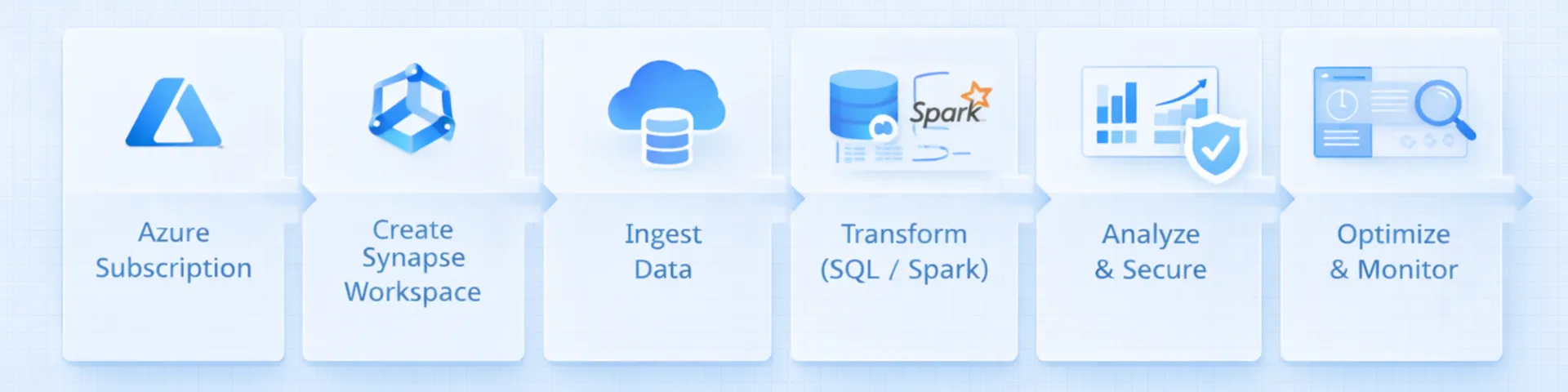
- Set Up Environment – Define your Azure subscription, permissions, and networking.
- Create Synapse Workspace – Provision a workspace and connect to Azure Data Lake Storage.
- Ingest Data – Use pipelines to pull data from on-premises, cloud, or streaming sources.
- Transform Data – Cleanse and enrich data using SQL or Spark notebooks.
- Analyze & Visualize – Run advanced analytics and integrate with Power BI dashboards.
- Secure & Govern – Apply encryption, access controls, and monitoring.
- Iterate & Optimize – Continuously tune performance and scale resources to business needs.
Best Practices
- Monitor and optimize compute usage to avoid unnecessary costs.
- Use partitioning and optimal file formats (Parquet, ORC) for faster query performance.
- Implement workload isolation to handle concurrency effectively.
- Integrate metadata and governance with tools like Microsoft Purview.
- Apply security best practices, including encryption, auditing, and identity management.
Why Choose Azure Synapse Analytics?
Azure Synapse brings together the power of big data, enterprise warehousing, and advanced analytics in a unified experience. By eliminating silos and accelerating insights, Synapse empowers organizations to make smarter, data-driven decisions while maintaining agility and security.
Ready to Modernize Your Data Strategy?
Our team can help you design, implement, and optimize Azure Synapse Analytics to fit your organization’s needs. Contact us to get started.
Microsoft Azure Synapse Tech: Complete Guide to Azure Synapse Analytics and Modern Data Platforms
Introduction
Synapse tech refers to Microsoft’s Azure Synapse Analytics, an enterprise-grade cloud platform that unifies data warehousing, big data analytics, and data integration into a single, cohesive environment. This platform enables organizations to query data across structured data sources and data lakes using both serverless and dedicated resources, eliminating the traditional silos between analytics workloads.
At MOST Programming, we are committed to building strong relationships with our clients by providing personalized service and support that ensures every digital solution aligns with your business goals. We focus on understanding your specific needs and deliver custom solutions, including tailored document management systems and business process automation tools to help you cut costs, save time, and enhance decision-making.
This guide covers Azure Synapse Analytics comprehensively, including its core architecture, implementation strategies, and optimization techniques. The content is designed for data engineers, data scientists, and IT professionals who need to evaluate, deploy, or manage modern analytics platforms. Whether you’re migrating from legacy systems or building new data infrastructure, understanding synapse tech is essential for making informed decisions about enterprise data strategy.
Direct answer: Azure Synapse Analytics is Microsoft’s unified analytics platform that combines enterprise data warehousing with big data analytics, allowing organizations to ingest, prepare, manage, and serve data for immediate business intelligence and machine learning needs through a single synapse workspace.
By reading this guide, you will gain:
- Clear understanding of Azure Synapse Analytics core components and architecture
- Practical implementation knowledge for deploying synapse environments
- Best practices for data integration and pipeline management
- Integration capabilities with Power BI, Apache Spark, and other Azure services
- Cost optimization strategies for both serverless and dedicated SQL pools
Understanding Synapse Technology Fundamentals
Synapse tech represents a paradigm shift in how enterprises approach data analytics and cloud computing. Rather than maintaining separate systems for data warehousing, big data processing, and business intelligence, Azure Synapse brings these capabilities together under one platform. This unified experience eliminates data movement inefficiencies and reduces the complexity of managing multiple tools. Synapse Technologies offers custom solutions for businesses across multiple industries to streamline operations and reduce costs.
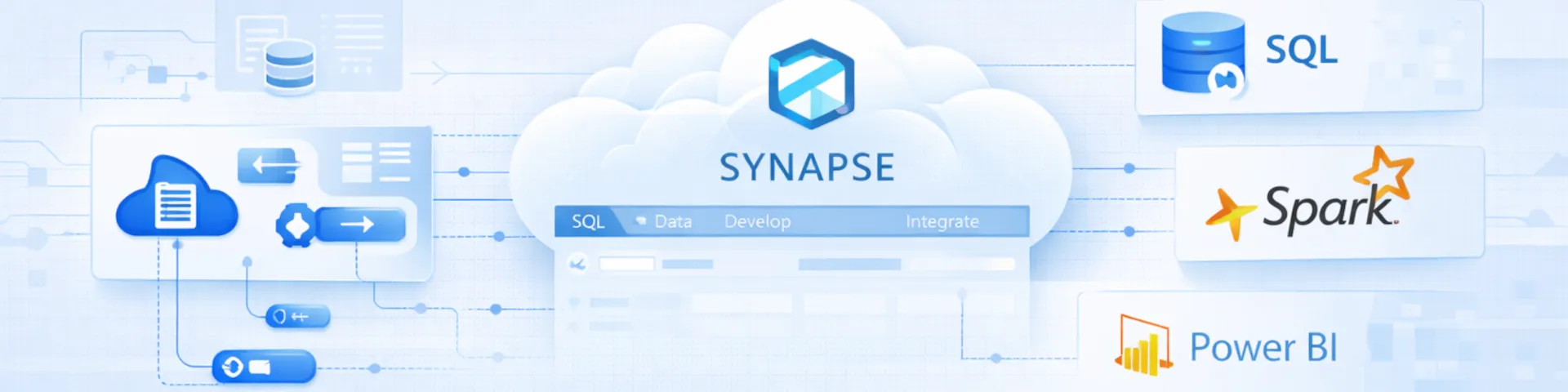
For organizations dealing with large datasets from diverse sources, transactional databases, IoT data, application logs, and external feeds, synapse technology provides the scalability and flexibility needed to derive value from all data types without architectural compromises.
Core Components of Azure Synapse Analytics
Azure Synapse Analytics consists of several integrated components that work together to deliver comprehensive analytics capabilities.
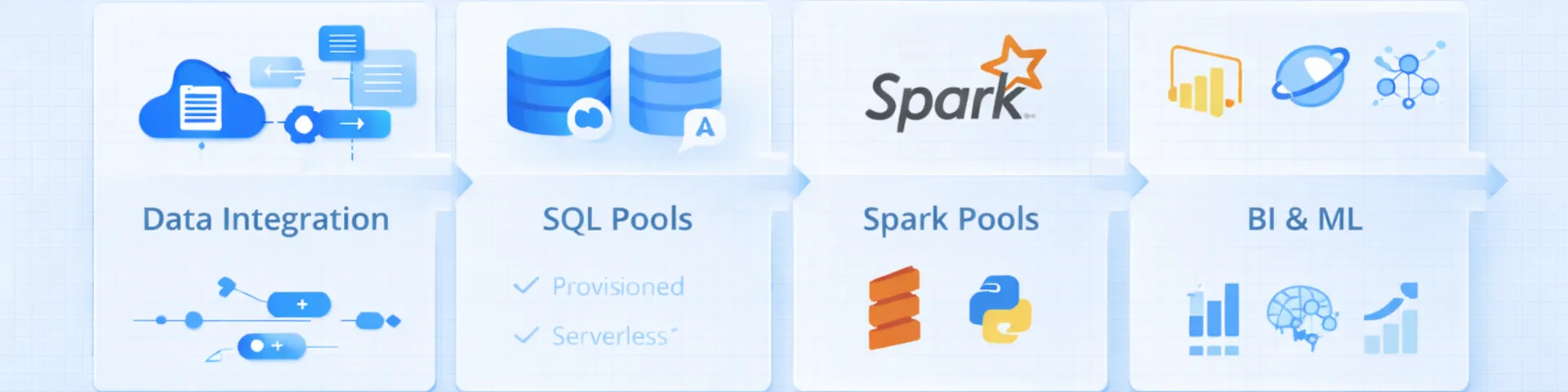
Data integration forms the foundation, with built-in connectors supporting 90+ data sources. The platform offers both code-free and code-based approaches to ETL/ELT processes, allowing teams to efficiently move and transform data regardless of their expertise level. Azure Data Factory pipelines integrate natively, enabling complex orchestration of data workflows.
SQL pools provide the compute power for querying and analysis. Serverless SQL pools let you query data directly in your data lake without provisioning infrastructure, you pay only for the data processed. Dedicated SQL pools offer reserved compute capacity for predictable performance on demanding enterprise data warehousing workloads, processing petabytes of structured data with sub-second response times. The data warehouse can store and analyze various types of files, such as Excel sheets and XML files, for reporting and analysis.
Apache Spark integration enables big data processing, machine learning model development, and advanced analytics. Data engineers and data scientists can run Spark jobs using Python, Scala, .NET, or SQL, with seamless integration into the broader synapse environment. Azure Synapse supports comprehensive data engineering workflows, including data preparation, ETL, and machine learning, using technologies like Apache Spark and Data Explorer.
Synapse Studio Environment
Synapse Studio serves as the unified development interface for all analytics activities. This web-based workspace consolidates data exploration, SQL scripts development, Spark notebook authoring, pipeline orchestration, and monitoring into a single pane of glass.
Collaboration features enable teams to manage code, share assets, and maintain version control across projects. Role based access control ensures secure access to sensitive data and operations, while integration with other Azure services like Azure Active Directory streamlines authentication.
The studio’s design reflects Microsoft’s commitment to productivity, users can move from data ingestion to visualization without switching tools, significantly reducing the friction in analytics workflows.
Azure Synapse Analytics in Practice
With the foundational components understood, examining how Azure Synapse operates in real-world scenarios reveals its practical value for enterprise analytics.
Data Warehousing Capabilities
Azure Synapse excels at enterprise data warehousing, supporting workloads that process hundreds of terabytes daily. The platform uses massively parallel processing (MPP) architecture to distribute queries across compute nodes, enabling complex analytical queries to complete in seconds rather than hours.
Performance optimization features include adaptive query processing, materialized views, and result set caching. Organizations can scale compute resources independently of storage, paying only for the capacity needed during peak periods. This elasticity makes dedicated SQL pools cost-effective for businesses with variable analytical demands.
SQL-based querying supports familiar T-SQL syntax, reducing the learning curve for database professionals. Analysts can query data in the data lake directly or load it into optimized columnstore tables for maximum performance on recurring reports and dashboards.
Big Data Processing
Apache Spark integration transforms Azure Synapse into a comprehensive big data analytics platform. Distributed computing capabilities handle processing tasks that would overwhelm traditional databases, analyzing billions of records, training machine learning models on historical data, or performing real-time streaming analysis.
Real-time analytics capabilities support scenarios like fraud detection, predictive maintenance, and live dashboard updates. The platform can ingest streaming data from Event Hubs, Kafka, or IoT Hub, process it through Spark Structured Streaming, and land results into analytics tables within seconds.
Machine learning development benefits from native integration with Azure Machine Learning and MLflow. Data scientists can prototype models in Spark notebooks, then deploy them as scalable endpoints or embed predictions directly in SQL queries using the PREDICT function.
Business Intelligence Integration
Power BI connectivity is deeply embedded in Azure Synapse, enabling seamless integration between data preparation and visualization. Direct Query mode lets reports access live data without duplication, while Import mode supports high-performance dashboards with cached datasets.
Report generation and data visualization capabilities extend to both technical and business users. Analysts create sophisticated reports using familiar tools, while business users leverage self-service analytics to explore data without IT intervention.
The combination of governed data assets and accessible visualization tools accelerates decision making across organizations, turning raw data into actionable insights efficiently.
Data Lake Storage
Azure Synapse Analytics delivers cutting-edge integration with Azure Data Lake Storage, providing your organization with a highly scalable and secure foundation that addresses real-world analytics challenges. This powerful integration enables your data engineers and data scientists to efficiently access, manage, and analyze large datasets, whether structured, semi-structured, or unstructured, directly within the synapse environment, helping you make informed, strategic decisions with greater confidence. By leveraging Azure Data Lake, you can store vast amounts of raw data in its native format, making it ideal for your big data analytics and enterprise data warehousing scenarios that drive results.
With Azure Synapse, you can query data directly from the data lake without the need for time-consuming data movement or duplication, streamlining your analytics processes while helping you reduce operational costs and stay ahead in an increasingly competitive landscape. The platform's ability to handle big data at scale empowers your organization to unlock actionable insights from all types of azure data, supporting advanced analytics and data-driven decision making that align with your business goals. The secure and flexible architecture ensures that your sensitive data remains protected while enabling authorized users to access and analyze information as needed, delivering tailored solutions that harness the full potential of these advanced technologies.
Machine Learning
Azure Synapse Analytics delivers a robust platform that enables you to build, deploy, and manage machine learning models, making advanced analytics accessible and driving real-world results for your organization. Through seamless integration with Azure Machine Learning and other azure services, you can develop sophisticated models using popular frameworks such as TensorFlow, PyTorch, and scikit-learn, harnessing the full potential of these cutting-edge technologies. The platform also supports automated machine learning, enabling you to create predictive models that drive results without requiring deep machine learning expertise.
Once you've developed your models, Azure Synapse makes it easy to deploy them as web services, allowing your organization to embed machine learning into business applications and analytics workflows that address real-world challenges. This integration accelerates your decision making and drives significant business value by enabling real-time predictions and actionable insights that help you stay ahead in an increasingly competitive landscape. Additionally, the tight connection with Power BI and other azure services means you can quickly visualize model results and share findings across your business.Azure Synapse's unified platform ensures that machine learning becomes a core part of your overall data analytics strategy, not an isolated process, enabling you to harness the full potential of intelligent systems that align with your strategic business goals.
Implementation and Setup Process
Deploying Azure Synapse Analytics requires careful planning to align technical configuration with business requirements and budget constraints.
Prerequisites and Planning
Before creating a synapse workspace, ensure your environment meets the necessary prerequisites:
- Azure subscription setup: Create or confirm access to an active Microsoft Azure subscription with appropriate spending limits and billing configuration
- Data Lake Storage Gen2 creation: Provision an Azure Data Lake Storage Gen2 account as the primary storage layer for your analytics platform
- Resource group configuration: Organize your Azure resources within a logical resource group for management, monitoring, and cost tracking
- Security and access planning: Define role based access control policies, network security rules, and data encryption requirements before deployment
Synapse Workspace Configuration
Choosing the right configuration depends on your workload characteristics, performance requirements, and budget:
| Criterion | Serverless SQL Pool | Dedicated SQL Pool |
|---|---|---|
| Billing model | Pay per TB processed | Hourly compute rate |
| Best for | Ad-hoc queries, exploration | Predictable, heavy workloads |
| Performance | Variable, based on query | Guaranteed, reserved capacity |
| Scaling | Automatic | Manual or scheduled |
| Cost profile | Lower for sporadic use | Lower for consistent high usage |
For most organizations, a hybrid approach works best: use serverless pools for data exploration and development, then migrate production workloads to dedicated resources as usage patterns stabilize. This strategy balances costs while ensuring performance where it matters most.
Organizations implementing Azure Synapse often benefit from expert guidance. Contact us to design a scalable and secure architecture.
Common Challenges and Solutions
Implementing and operating Azure Synapse Analytics presents predictable challenges that organizations can address with proven strategies.
Cost Management and Optimization
Controlling expenses requires visibility and governance. For serverless pools, implement query timeouts and data layout optimization (partition pruning, file size tuning) to minimize data scanned per query. Monitor consumption through Azure Cost Management and set budgets with alerts.
For dedicated SQL pools, pause resources during off-hours using automation. Many organizations reduce costs by 50% or more through scheduled scaling. Consider reserved capacity purchases for predictable workloads, offering up to 65% savings over pay-as-you-go pricing.
Data Integration Complexities
Connecting diverse data sources, from legacy databases to SaaS applications, demands thoughtful pipeline design. Use parameterized pipelines to handle multiple sources with consistent patterns, and implement error handling with retry logic and dead-letter queues for failed records.
Data quality gates within pipelines catch issues before they propagate. Validate row counts, schema conformance, and business rules at each transformation stage. Integrate data profiling to monitor for anomalies in source data over time.
Performance and Scaling Issues
Query optimization starts with understanding data distribution and access patterns. Use distribution keys that minimize data movement during joins, and maintain current statistics for the query optimizer. Implement workload management to prioritize critical queries during peak periods.
For large-scale processing, partition data by commonly filtered columns (date, region) and use appropriate file formats (Parquet for analytics, Delta for transactional workloads). These practices ensure consistent performance as data volumes grow.
Security and Access Control
Security and access control deliver foundational protection for your Azure Synapse Analytics environment, ensuring you can confidently manage sensitive data while meeting critical compliance requirements. The platform empowers you with comprehensive role-based access control capabilities, enabling your administrators to define precise, granular permissions that align with your organizational structure and security policies. This targeted approach ensures your teams access exactly the data, resources, and analytics operations they need, giving you complete control over your synapse environment while maintaining operational efficiency.
Azure Synapse arms your organization with cutting-edge security features including robust data encryption at rest and in transit, plus advanced network isolation options that create additional protective barriers around your valuable data assets. By integrating seamlessly with Azure Active Directory and other azure services, you gain access to a unified identity and access management solution that streamlines your user administration processes while strengthening security across your entire analytics platform. These powerful capabilities enable your organization to confidently analyze and manage data at scale, knowing that enterprise-grade security and compliance measures are actively protecting your assets and maintaining the trust your business depends on.
Use Cases and Applications
At our organization, we leverage Azure Synapse Analytics to support a comprehensive range of use cases and applications, helping you harness a versatile solution that addresses your organization's unique needs for modernizing data analytics infrastructure. Our approach combines this scalable and secure architecture with deep industry expertise to meet your specific requirements for enterprise data warehousing, big data analytics, data integration, and machine learning, enabling you to stay ahead in an increasingly data-driven business landscape and achieve your strategic goals with greater confidence.
Conclusion and Next Steps
Azure Synapse Analytics represents the current state of the art in unified analytics platforms, combining enterprise data warehousing, big data processing, and business intelligence capabilities into a single, manageable service. Organizations adopting this synapse tech gain the flexibility to address a broad range of analytical use cases without the complexity of managing disparate systems.
Getting started with Azure Synapse:
- Sign up for an Azure account or access your existing subscription
- Create a synapse workspace following the implementation guidance above
- Connect your first data source and build an initial pipeline
- Develop a pilot project demonstrating value to stakeholders
Alternative starting points:
- Complete Microsoft Learn’s Synapse Analytics learning paths for structured training
- Explore the Azure Synapse samples repository for implementation patterns
- Assess current data infrastructure for migration opportunities
Related technologies worth exploring include Azure Machine Learning for advanced model development and deployment, Azure Data Factory for complex hybrid data orchestration, and Power BI Premium for enterprise-scale reporting and analytics distribution.
Azure Synapse is often implemented as part of a broader data and analytics strategy. If you're evaluating how it fits into your environment, contact us to discuss your requirements.
Additional Resources
- Azure Synapse Analytics documentation - Comprehensive official guides and tutorials
- Microsoft Certified: Azure Data Engineer Associate - Professional certification path
- Azure Synapse Analytics pricing calculator - Cost estimation tool for planning
- Azure Architecture Center - Analytics solutions - Reference architectures and templates
- Microsoft Tech Community - Synapse Analytics - Community discussions and best practices
Other Relevant MOST Programming Resources
When implementing Azure Synapse Analytics for your organization, understanding how this powerful platform fits into a comprehensive data strategy can help you maximize your investment and achieve faster time-to-value. Our expertise in Data Flow Architecture ensures that your Synapse implementation includes robust, automated data pipelines that efficiently move and transform data from source systems into your unified analytics platform. This architectural foundation is essential for leveraging Synapse's data integration capabilities, enabling seamless orchestration of data ingestion, transformation, and movement across all your enterprise data sources without manual intervention.
Azure Synapse's deep integration with Power BI represents one of its most valuable capabilities for delivering actionable insights to business users across your organization. Our specialized work in Visualization with Power BI transforms the analytical power of Synapse into intuitive dashboards and interactive reports that make complex data accessible to stakeholders at every level. From real-time operational dashboards to executive-level strategic analytics, this integration enables you to turn Synapse's unified data warehouse into a comprehensive business intelligence solution that drives informed decision-making.
Many organizations benefit from seeing how Synapse-based solutions have solved real-world business challenges across different industries. Our Custom Restaurant Data Analytics Solutions case study demonstrates how we leveraged Azure cloud infrastructure to build a comprehensive analytics platform for a global restaurant organization, integrating multiple data sources and delivering Power BI dashboards to managers worldwide. This project showcases the scalability, security, and performance capabilities that make Azure Synapse an ideal foundation for enterprise analytics implementations.
The success of any Synapse deployment depends heavily on effective data integration strategies that consolidate information from disparate systems. Our Multi-Source Data Aggregation capabilities enable us to connect Synapse to your legacy systems, cloud platforms, streaming data sources, and hybrid environments, creating the unified data lakehouse that Synapse is designed to support. This comprehensive integration approach ensures that your analytics platform has access to complete, accurate information from across your entire business operation, maximizing the value of your Synapse investment.
Finally, understanding the broader context of how advanced analytics platforms deliver business value can help you set realistic expectations and measure success. Our AI and Machine Learning expertise complements Synapse's built-in capabilities for predictive analytics and machine learning, enabling you to build and deploy sophisticated analytical models directly within your unified analytics environment. This combination of enterprise data warehousing, big data processing, and advanced analytics empowers your organization to move beyond descriptive reporting to predictive insights that drive competitive advantage.
If you're ready to move forward with Azure Synapse implementation or optimization, contact us to design a solution aligned with your business needs.
FAQs related to Azure Synapse Development Services
What are Azure Synapse Development Services?
Azure Synapse Development Services help organizations design, build, and optimize analytics solutions on Azure Synapse Analytics, including data integration, data engineering, data warehousing, and advanced analytics in a single unified platform.
What is included in Azure Synapse Development Services?
Azure Synapse Development Services typically include architecture planning, Synapse workspace setup, data ingestion pipelines, SQL development for serverless and dedicated SQL pools, Spark engineering, performance tuning, security configuration, and production support.
What can Azure Synapse Development Services build inside Synapse?
Azure Synapse Development Services can deliver end-to-end solutions such as unified lakehouse patterns, enterprise data warehousing, ELT/ETL pipelines, real-time and log analytics workflows, and analytics datasets that power reporting and predictive use cases.
What is the difference between serverless SQL and dedicated SQL in Azure Synapse Development Services?
Azure Synapse Development Services support both options: serverless SQL is typically used for on-demand querying of data in the data lake without provisioning infrastructure, while dedicated SQL pools provide reserved compute capacity for predictable performance on enterprise data warehousing workloads.
How do Azure Synapse Development Services use Apache Spark pools?
Azure Synapse Development Services use Apache Spark pools for data engineering, large-scale transformations, advanced analytics, and machine learning workflows, including notebooks and scheduled processing pipelines.
How do Azure Synapse Development Services handle data pipelines and orchestration?
Azure Synapse Development Services implement data pipelines to ingest, transform, and move data across sources using Synapse pipelines with built-in Azure Data Factory capabilities for orchestration and scheduling.
What security and governance work is covered in Azure Synapse Development Services?
Azure Synapse Development Services can include access controls and governance features such as row-level and column-level security, dynamic data masking, auditing, encryption, and identity integration through Azure Active Directory.
What integrations are common in Azure Synapse Development Services?
Azure Synapse Development Services commonly integrate Synapse with Azure Data Lake Storage, Power BI, Azure Machine Learning, and other Azure data services to support end-to-end analytics and visualization workflows.
What types of use cases are best suited for Azure Synapse Development Services?
Azure Synapse Development Services are often used for real-time analytics, business intelligence enablement, predictive analytics, unified lakehouse patterns, and large-scale enterprise reporting across structured, semi-structured, and streaming data.
How do Azure Synapse Development Services improve performance and cost control?
Azure Synapse Development Services improve performance and cost control by selecting the right compute model, tuning queries and Spark jobs, optimizing data layouts, and actively monitoring resource usage to prevent unnecessary spend.
What are best practices used in Azure Synapse Development Services?
Azure Synapse Development Services often apply best practices such as partitioning, using efficient file formats like Parquet or ORC, workload isolation for concurrency, metadata governance practices, and secure identity and encryption standards.
What is the implementation process for Azure Synapse Development Services?
Azure Synapse Development Services typically follow a phased approach: discovery and requirements, workspace and storage setup, ingestion and transformation build, testing and validation, deployment and monitoring, then iteration and optimization as workloads evolve.