Build practical software that connects your systems, removes repetitive work, and turns data into useful products.
Discover MorePython Development Services: A Practical Guide for Business Leaders
Python is often described as an easy programming language to learn. While its readable syntax is certainly helpful, that is not the main reason businesses choose it.
Python’s real strength is its flexibility. The same language can support customer portals, internal APIs, automated reporting, data pipelines, and artificial intelligence services. This gives organizations the freedom to solve different problems without introducing a completely different technology for every part of the business.
That flexibility does not mean every Python solution should be designed in the same way. A public-facing application has different performance and security needs from a nightly reporting process. Likewise, an AI experiment that works well in a notebook may still need significant work before it is ready for real users.
In this guide, we explain where Python works best, what professional Python development should include, and how to decide whether it is the right choice for your project.
What Is Python?
Python is an open-source, general-purpose programming language used for web development, software integration, automation, data engineering, analytics, and artificial intelligence. Developers can use it for a small script or organize it into modules, packages, and services that support a large production system.
Its syntax is deliberately readable, and the standard library covers many everyday development tasks. A much larger package ecosystem adds frameworks and tools for web applications, APIs, numerical computing, data processing, cloud services, and machine learning.
Modern Python also supports type annotations. These do not enforce types at runtime, but they help editors, linters, and static-analysis tools catch mistakes and make service contracts easier to understand. For network-heavy work, Python’s asynchronous features can handle multiple I/O operations without waiting for each one to finish before starting the next.
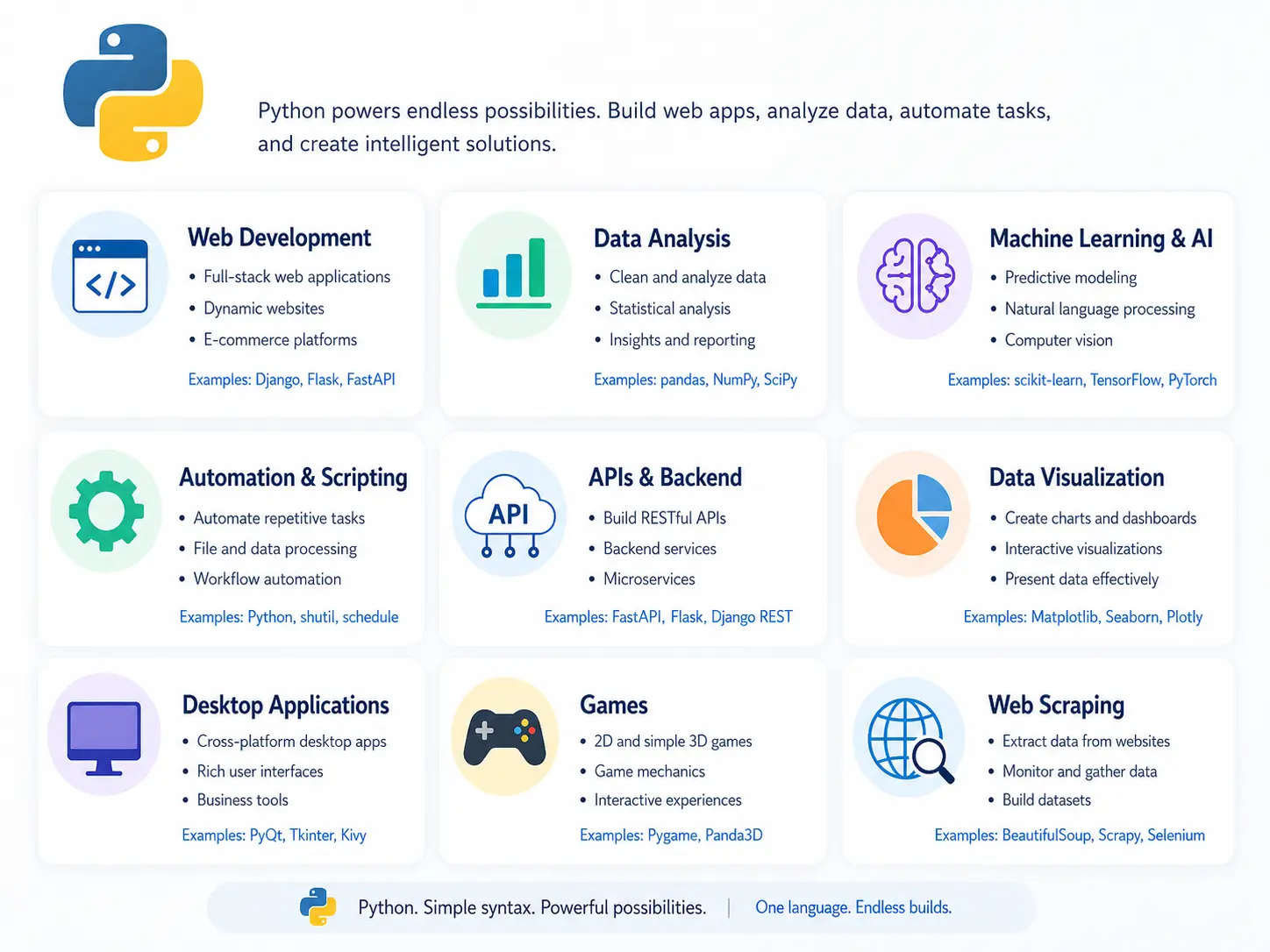
Python is used across application development, integration, automation, data, AI, and cloud workloads.
Why Businesses Choose Python
It can solve more than one kind of problem
A Python team can build an API, process incoming files, automate a scheduled report, and prepare data for a forecasting model without constantly changing technology stacks. That does not mean every component should be one large application; it means the organization can share skills and standards across several services.
It supports fast, evidence-based delivery
Python is well suited to projects where teams need to test an idea with real users or real data before committing to a large build. A small proof of concept can validate an integration, workflow, or model early. Once the direction is clear, the same work can be restructured into a production-ready service rather than thrown away and restarted from scratch.
It works well with existing systems
Most organizations are not starting with a blank technology landscape. Python can consume REST or GraphQL APIs, connect to relational and document databases, exchange messages through queues, work with files and cloud storage, and expose services to frontends built with React, Vue, or other technologies.
It has a strong data and AI ecosystem
Python is widely used where application development meets data. Teams can collect and validate information, prepare it for reporting, train or evaluate models, and make the results available through an API or business application. The challenge is usually not finding a library; it is selecting a small, supportable set of tools and building the controls around them.
How a Python Solution Fits Together
A production Python solution is more than a collection of scripts. It normally has a clear entry point, a place for business rules, controlled access to data, integration boundaries, background processing, and operational monitoring.
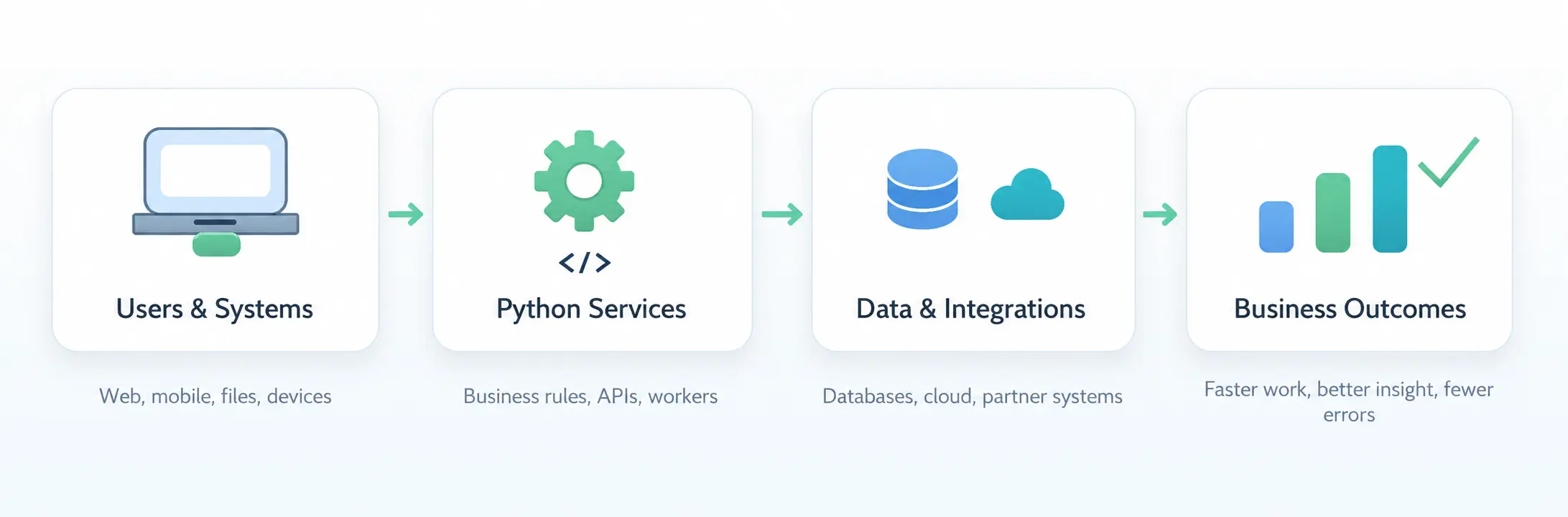
A practical Python architecture turns requests and data into reliable business outcomes through clear service and integration boundaries.
The exact design depends on the workload. A customer-facing application may need low-latency APIs and strict permission checks. A nightly data process may care more about restartability, reconciliation, and audit history. A model-serving service may need versioned models, input validation, and monitoring for changes in prediction quality.
Python Development Services
Custom Python Application Development
We build business applications around specific workflows rather than forcing an organization into a generic product. Typical projects include customer and employee portals, administration systems, approval workflows, scheduling tools, reporting applications, and operational platforms.
Python API and Integration Development
Python is a practical choice for APIs that connect frontends, mobile applications, partner systems, and internal platforms. Our work can include authentication, authorization, request validation, versioning, error handling, documentation, rate controls, and observability not only endpoint development.
Data Engineering and Data Quality
Reliable reporting and AI depend on reliable data. We design pipelines that collect, validate, transform, reconcile, and deliver information across files, APIs, operational databases, cloud storage, and analytical platforms. Where a process fails, the system should explain what failed, preserve enough context to investigate it, and support a controlled retry.
Business Process Automation
Many Python projects begin with a task that someone performs manually every day or every week. Automation may include reading files, checking data, updating another system, creating a report, or sending a notification. The best candidates are repetitive, rule-based processes with clear inputs, outputs, and exception paths.
AI and Machine-Learning Integration
We help organizations move AI work beyond a notebook or isolated experiment. That can mean preparing data, evaluating a model, exposing predictions through an API, integrating an external AI service, or adding human review to a document or classification workflow. The goal is not to add AI everywhere; it is to use it where it improves a measurable process.
Python Modernization and Support
Older Python systems often contain valuable business logic but carry unsupported versions, abandoned dependencies, limited tests, or fragile deployments. Modernization can be phased: first stabilize the application, then upgrade dependencies, improve tests and typing, separate integrations, and introduce repeatable deployment and monitoring.
Common Python Use Cases
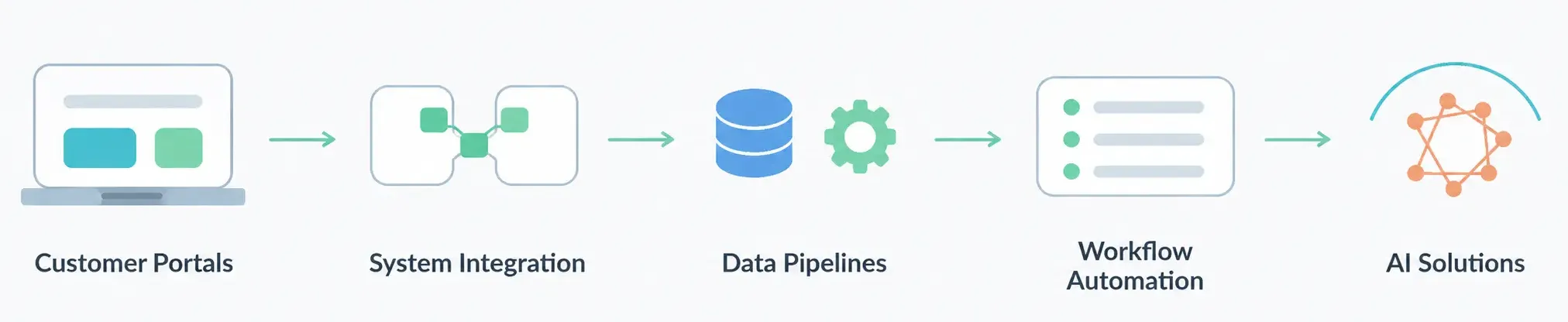
Python can support customer-facing products and the data, integration, automation, and AI services behind them.
Customer and employee portals
Secure portals that give users access to account information, documents, requests, reports, and workflow actions.
System integration
Services that synchronize information between ERP, CRM, finance, analytics, partner, and cloud platforms.
Data pipelines
Scheduled or event-driven processes that ingest, validate, transform, and deliver data for operational and analytical use.
Workflow automation
Reliable jobs that replace repetitive file handling, reporting, notifications, and cross-system updates.
AI-enabled applications
Document processing, classification, forecasting, search, recommendation, and decision-support features integrated into existing workflows.
Internal tools
Focused applications that replace spreadsheets or manual handoffs without requiring a large commercial platform.
Choosing a Python Framework
Framework selection should follow the problem, not the popularity chart. Django, FastAPI, and Flask can all be good choices, but they solve different kinds of development problems.
| Framework | A good fit when | What it gives you | Watch for |
|---|---|---|---|
| Django | You need a substantial database-backed web application with established conventions. | An ORM, authentication, admin capabilities, forms, routing, and a cohesive project structure. | It can be more framework than a small service needs. Teams should work with its conventions rather than against them. |
| FastAPI | You are building typed APIs, integration services, or asynchronous network applications. | Type-driven validation, OpenAPI documentation, dependency injection, and modern async support. | A complete product still needs decisions around data access, background work, permissions, and project structure. |
| Flask | You want a small, flexible web service and prefer to select the supporting components yourself. | A lightweight foundation that is quick to start and can grow into a larger application. | Flexibility can turn into inconsistency unless the team establishes architecture and package standards early. |
When Python Is a Good Fit and When It Is Not
Python is a strong choice when the project involves business rules, system integration, data processing, automation, APIs, analytics, or AI. It is also useful when requirements are still being refined and the team needs to validate a solution quickly.
It may not be the first choice for every workload. A device with very limited resources, a hard real-time system, or a highly specialized compute engine may benefit from another language. Even inside a Python platform, performance-critical work can be handled by optimized databases, native libraries, managed services, or a separate service written in another technology.
A practical rule Choose Python because it fits the workload and the team not because it can technically be used for almost anything. |
Performance and Scalability
Application performance is usually influenced more by architecture and data access than by the programming language alone.
Common causes of poor performance include:
- Slow database queries
- Missing database indexes
- Repeated calls to external services
- Large response payloads
- Unnecessary file processing
- Long-running work inside a user request
- Poor caching decisions
Performance work should begin with measurement.
We examine how the application behaves under real workloads, identify where time and resources are being used, and then apply an appropriate solution.
That may involve:
- Improving database queries
- Adding indexes
- Introducing caching
- Processing data in batches
- Moving work to background jobs
- Using asynchronous I/O
- Scaling services horizontally
- Using optimized numerical libraries
Asynchronous programming is helpful when an application spends time waiting for databases or network services. It does not automatically make CPU-intensive work faster.
For heavy calculations, the better answer may be worker processes, native libraries, cloud compute services, or a dedicated service designed for that workload.
Security, Testing, and Operations
Security has to be built across the application, not added as a final review item. Protected actions should be authorized on the server, inputs and uploaded files should be validated, secrets should be stored outside the source code, and dependencies should be monitored and upgraded in a controlled way.
Testing should reflect business risk. Unit tests are useful for rules and calculations, but critical workflows also need integration tests against databases and external services, API contract tests, data-quality checks, and end-to-end coverage. For data and AI systems, testing should include the quality and shape of the input data as well as the code.
After deployment, logs, metrics, traces, alerts, backups, and clear operational ownership matter as much as the initial build. A job that runs every night is only valuable if someone knows when it fails and can safely restart it.
Our Python Development Process

A focused delivery process tests the riskiest assumptions early and improves the solution through evidence and feedback.
1. Discover
We clarify the users, current workflow, business outcome, data sources, integrations, risks, and non-negotiable constraints.
2. Prototype
We test the riskiest assumption first. That may be an external integration, a data-quality question, a performance target, or whether an AI approach produces useful results.
3. Build
We deliver the solution in small, reviewable increments. Stakeholders see working software early, and technical decisions are documented as the architecture develops.
4. Launch
We prepare production configuration, deployment, database changes, security controls, monitoring, support procedures, and rollback options.
5. Improve
We use user feedback, operational data, and business results to decide what should change next rather than expanding the system by assumption.
Why Choose MOST Programming for Python Development??
Python projects often sit at the intersection of several business and technical problems.
A project may require information from multiple systems to be collected and reconciled.It may need to replace a manual process people have relied on for years.It may introduce predictive analytics into an existing workflow or it may need to connect a modern application with older software that the business cannot simply replace.
MOST Programming brings together experience in:
- Application development
- System integration
- Data engineering
- Analytics
- Cloud services
- Business automation
- Artificial intelligence
We begin with the business problem and make the technical trade-offs clear.
Our approach includes:
- Architecture based on the actual workload
- Clear application, service, and integration boundaries
- Security and testing from the beginning
- Monitoring and support planning before launch
- Phased modernization where a complete rewrite would create unnecessary risk
- Communication that explains technical decisions in practical business terms
Our goal is to deliver a solution that works today and remains understandable, maintainable, and useful as the business grows.
It is to understand the problem, make the technical trade-offs clear, and build software that can be maintained and operated after development is complete.
Our Python predictive service-planning project is one example of that approach,starting with historical operational data and exploring how it could be turned into useful information for better planning decisions.
Conclusion and Next Steps
Python is a strong foundation for web applications, APIs, automation, data engineering, and AI but the language is only one part of a successful system. The real value comes from choosing the right architecture, protecting the data, designing for failure, and building around the people who will use and support the solution.
A useful first step is to identify one workflow or product outcome that matters, then map the systems, data, risks, and users involved. From there, MOST Programming can help evaluate the best approach, test the critical assumptions, and define a practical delivery plan.
Frequently Asked Questions
What does a Python development company do?
A Python development company plans, builds, integrates, tests, deploys, and supports software written in Python. The work may include business applications, APIs, automation, data pipelines, analytical systems, AI services, and modernization of existing Python platforms.
Is Python suitable for enterprise applications?
Yes, when the solution includes clear architecture, server-side authorization, controlled dependencies, automated testing, monitoring, and a deployment model that matches the workload. Enterprise readiness comes from engineering practices, not from the language alone.
Can Python be used for web development?
Yes. Django is commonly used for substantial database-backed applications, FastAPI for modern APIs and integration services, and Flask for lightweight, flexible web services. The best choice depends on the product and the team.
Can Python connect to our existing software?
In most cases, yes. Python can consume and expose APIs, connect to databases, process files, work with message queues and cloud SDKs, and integrate with platforms built in .NET, Java, Node.js, PHP, and other technologies.
Is Python a good choice for automation?
Python is a strong fit for repetitive, rule-based work such as file processing, validation, reporting, notifications, and system-to-system updates. Reliable automation should include logging, exception handling, audit history, and a clear process for failed items.
Why is Python widely used for data and AI?
Python combines readable application code with mature libraries for numerical computing, data processing, visualization, and machine learning. This makes it easier to connect analysis and experimentation with production services and business applications.
Can Python applications scale?
Yes. Scaling typically involves efficient database access, caching, queues, asynchronous I/O where appropriate, background workers, stateless service design, and horizontal infrastructure. The correct pattern depends on whether the workload is interactive, batch, streaming, or compute-heavy.
How secure is Python?
Python can be used to build secure systems, but security depends on the implementation. Authentication, authorization, validation, secret management, dependency controls, logging, infrastructure permissions, and patching all need to be addressed.
Should an older Python system be rewritten?
Not automatically. A phased modernization is often safer: stabilize the system, add tests and monitoring, upgrade unsupported components, isolate integrations, and replace the highest-risk areas first. A rewrite is justified only when the existing architecture prevents reasonable improvement.
How long does a Python project take?
The timeline depends on the workflows, integrations, data readiness, user roles, security needs, and deployment requirements. A focused integration or automation can be delivered in phases, while a large enterprise platform requires broader discovery and staged delivery.
How much does Python development cost?
Cost depends on scope, complexity, integrations, data quality, design, security, testing, infrastructure, and support. A short discovery phase is usually the best way to produce a credible estimate.
Does MOST Programming provide ongoing support?
Yes. Support can include defect resolution, dependency and security upgrades, performance improvements, monitoring, data-pipeline troubleshooting, feature development, integration changes, and cloud modernization.