Expert MySQL Development Company Delivering High-Performance Database Solutions
MySQL Development Services: Complete Guide to Database Solutions for Modern Businesses
Introduction
MySQL development services deliver comprehensive database solutions that encompass custom database design, performance optimization, data migration, and ongoing maintenance for organizations requiring robust data infrastructure. These expert mysql development services address the full lifecycle of database operations, from initial schema modeling through long-term database health monitoring.
A dedicated mysql development team, led by senior MySQL engineers and experienced delivery managers, ensures smooth project execution and seamless integration with enterprise workflows.
If you're evaluating MySQL for a new application or modernization effort, contact our team to discuss requirements, risks, and timeline.
This guide covers enterprise database development, data analytics integration, and cloud infrastructure services for MySQL environments. It targets CTOs, IT managers, and business leaders seeking scalable database solutions to power their data-driven operations. Basic MySQL tutorials and introductory concepts fall outside this scope—instead, we focus on strategic implementation decisions and vendor evaluation criteria that drive business growth.
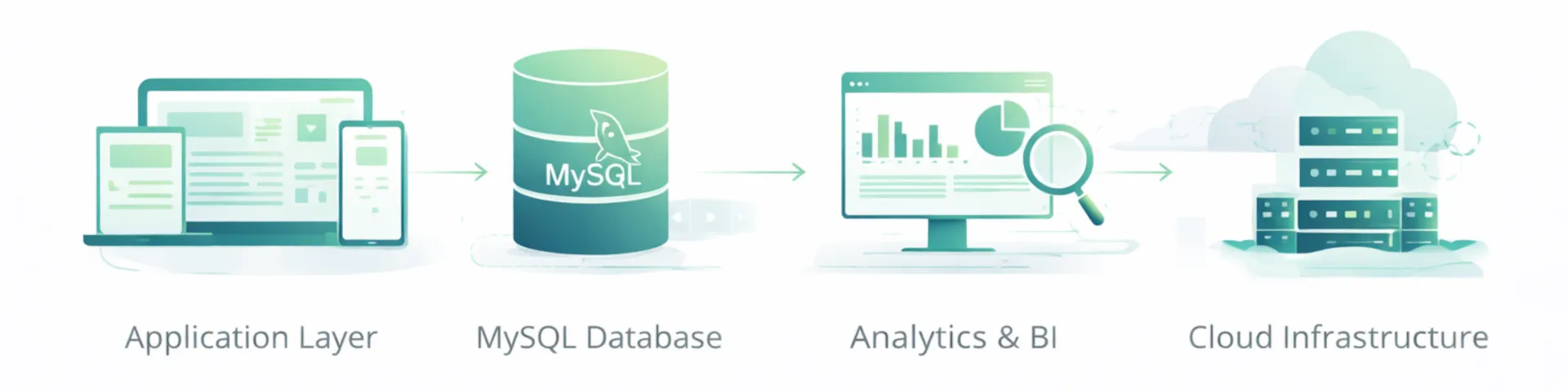
MySQL development services encompass custom database design, performance optimization, mysql data migration, and continuous support to build the foundation for business intelligence and analytics platforms. Skilled mysql developers implement mysql’s advanced features to ensure data integrity, optimal performance, and reliable access to mission-critical information.
Key outcomes from this guide:
- Understanding the full spectrum of mysql database services and their business applications
- Evaluating implementation approaches and development process methodologies
- Identifying cost factors and realistic development timeline expectations
- Establishing vendor selection criteria based on proven track record indicators
- Calculating ROI expectations for database infrastructure investments
Benefits of MySQL Database
The MySQL database delivers a powerful suite of benefits that make it a preferred choice for organizations seeking efficient data management and robust application performance. One of the core strengths of MySQL database services is their ability to ensure data integrity, safeguarding business-critical information against corruption or loss. Skilled MySQL developers leverage advanced features such as stored procedures and sophisticated indexing strategies to optimize queries, resulting in faster response times and more reliable web applications.
MySQL’s flexibility extends to its compatibility with various programming languages, allowing development teams to integrate MySQL databases seamlessly into diverse technology stacks and complex solutions. This adaptability is especially valuable for businesses managing large data volumes or requiring custom workflows. With built-in mechanisms to restrict unauthorized access, MySQL helps protect sensitive data, supporting compliance and data security initiatives.
By utilizing MySQL database services, organizations benefit from streamlined data management processes, reduced operational overhead, and the ability to scale as business needs evolve. Whether supporting high-traffic web applications or intricate business logic, MySQL empowers companies to manage data efficiently and maintain a competitive edge in today’s digital landscape.
Understanding MySQL Development Services
MySQL development services represent specialized technical offerings focused on database infrastructure and data management solutions. These services leverage MySQL’s position as an ACID-compliant relational database management system capable of handling everything from web applications to petabyte-scale enterprise deployments.
Modern businesses require mysql solutions that support data analytics, business intelligence dashboards, and multi-source data aggregation. As organizations accumulate data volume from diverse sources, the need for efficient data management becomes critical to maintaining competitive advantage and enabling informed decision-making.
Custom Database Development
Custom mysql database development involves designing tailored database architecture that addresses specific business requirements rather than forcing operations into generic templates. This includes schema modeling optimized for your unique data relationships, stored procedures that encapsulate complex business logic, and views that simplify data access for end users.
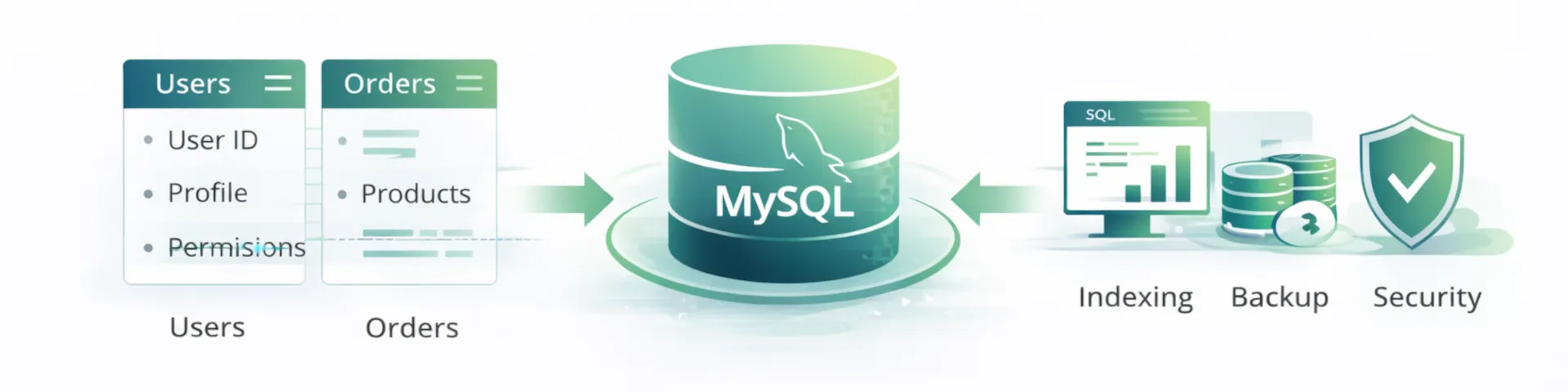
The connection to broader data strategy is direct: well-designed mysql databases serve as the foundation for data warehouse creation, ETL processes, and analytics platform infrastructure. Database design decisions made during initial development affect everything from query performance to the complexity of future integrations with business intelligence tools.
Need a MySQL schema designed for performance and analytics? Contact us to plan a database architecture aligned with your business goals.
Performance Optimization Services
MySQL performance optimization services focus on query optimization, indexing strategies, and caching implementation that transform sluggish database operations into high-performance systems. These services analyze slow queries via EXPLAIN plans, refine indexes on frequently queried columns, and tune parameters like innodb_buffer_pool_size to maximize hardware utilization.
The relationship to business operations is measurable: optimized databases enable responsive business intelligence dashboards and real-time analytics capabilities. Organizations typically achieve 50-90% latency reductions through systematic performance tuning without requiring hardware upgrades—directly impacting user satisfaction and operational efficiency.
If your MySQL environment struggles under load, a structured performance assessment can identify bottlenecks and optimization opportunities.
Migration and Integration Solutions
Legacy system modernization and cross-platform data integration represent essential mysql integration services for organizations evolving their technology stack. The migration process handles transitions from systems like Oracle or SQL Server using tools such as MySQL Workbench Migration Wizard, including schema conversion, data cleansing, and validation procedures designed for minimal downtime.
These foundational services combine into comprehensive offerings that address the complete database lifecycle, setting the stage for examining specific service deliverables in detail.
Core MySQL Development Service Offerings
Building on these foundational concepts, mysql services translate into concrete business applications through specific deliverables. Organizations engage mysql development teams to address particular operational needs, from building new database infrastructure to integrating mysql with existing data ecosystems.
Enterprise Database Architecture
Enterprise database development delivers scalable architecture for organizations managing multiple data sources, complex reporting requirements, and high user loads. This includes implementing master-slave replication for read scaling, InnoDB Cluster configurations for automated failover, and sharding strategies that distribute data across instances for horizontal growth.
Mysql professionals design normalized schemas that reduce redundancy while creating denormalized views for fast reporting—balancing data integrity with performance requirements. Architecture decisions account for projected growth, enabling systems to handle 10x data volume increases without fundamental redesign.
Business Intelligence Integration
MySQL database services optimized for business intelligence ensure that Power BI dashboards, data visualization platforms, and predictive analytics systems receive data efficiently. This involves creating optimized query paths for common analytical patterns, implementing read replicas that offload reporting workloads, and establishing smooth data flow between operational and analytical systems.
Mysql experts configure databases to support complex queries required by modern BI tools while maintaining the transaction processing performance that business processes demand. The goal is enabling real-time insights without degrading the database operations that power daily activities.
Cloud Database Solutions
Cloud mysql development deploys databases on AWS RDS, Google Cloud SQL, and Azure Database for MySQL with automation and monitoring capabilities that reduce operational overhead. These mysql solutions leverage managed services like HeatWave for in-memory analytics while maintaining the flexibility to optimize configurations beyond default settings.
Cloud deployments connect directly to cost optimization through pay-as-you-go models and elastic scaling. Organizations reduce infrastructure management burden while gaining access to monitoring tools, automated backups, and disaster recovery capabilities that would require significant investment to replicate on-premises.
If you're considering AWS RDS, Azure Database for MySQL, or Google Cloud SQL, contact us to design a secure, cost-aware deployment.
Implementation Process and Methodologies
Executing mysql projects requires structured methodologies that balance thorough planning with adaptability. The development process follows established phases while remaining responsive to discoveries made during implementation.

Database Assessment and Planning
Comprehensive assessment forms the foundation for successful mysql development. This phase is essential when organizations face database health concerns, performance degradation under growing loads, or requirements for new capabilities.
- Current system analysis and performance benchmarking — Evaluate existing data infrastructure, identify bottlenecks, and establish baseline metrics for measuring improvement
- Business requirements gathering and stakeholder interviews — Document data management needs, reporting requirements, and integration points with other business operations
- Architecture design and scalability planning — Create database design specifications addressing current needs and anticipated business growth
- Migration strategy and development timeline establishment — Define phased implementation approach with rollback procedures and success criteria
Development Approach Comparison
Selecting the appropriate methodology affects cost, timeline, and risk profile for your mysql project:
| Criterion | Agile | Waterfall | Hybrid |
|---|---|---|---|
| Timeline | Iterative sprints, flexible | Fixed phases, sequential | Core phases fixed, details flexible |
| Cost | Variable, ongoing refinement | Defined upfront | Baseline with change provisions |
| Risk Level | Lower through early feedback | Higher if requirements shift | Moderate, managed through checkpoints |
| Client Involvement | High, continuous collaboration | Lower after requirements phase | Structured touchpoints throughout |
For database development where requirements are well-understood and integrate mysql with established systems, waterfall approaches provide predictability. Projects involving complex solutions with evolving requirements benefit from agile methodologies that allow mysql developers to adapt as insights emerge.
Common Challenges and Solutions
MySQL development projects encounter predictable obstacles that experienced database administrators and mysql professionals address through proven approaches.
Performance Bottlenecks in High-Traffic Applications
Query optimization through EXPLAIN analysis identifies inefficient execution paths, while indexing strategies on frequently queried columns reduce scan times by orders of magnitude. Connection pooling prevents resource exhaustion, and read replica implementation offloads 80-90% of read operations from primary servers. Mysql performance optimization addresses these bottlenecks systematically, achieving optimized performance without hardware scaling.
Data Migration Complexity from Legacy Systems
Phased migration with parallel testing enables validation before cutover, protecting existing data while transitioning to new infrastructure. The migration process employs tools like pt-online-schema-change for zero-downtime alterations, with rollback procedures ensuring recovery options remain available. Mysql data migration services typically achieve 99.99% uptime during transitions through careful staging.
Security and Compliance Requirements
Data encryption at rest and in transit protects sensitive data, while role-based access controls restrict unauthorized access to appropriate boundaries. Security audits identify vulnerabilities, and audit trail implementation supports GDPR and PCI-DSS compliance requirements. Database security extends to prepared statements preventing SQL injection and regular vulnerability assessments maintaining data protection standards.
Business Growth and Success
MySQL database development plays a pivotal role in driving business growth and long-term success. By investing in expert MySQL development services, companies can build a robust database infrastructure that supports their evolving business processes and performance requirements. Through meticulous database design and performance optimization, MySQL databases deliver optimal performance, ensuring that mission-critical applications run smoothly and efficiently.
MySQL integration services enable seamless connectivity between MySQL databases and other enterprise systems, promoting smooth data flow and interoperability across the organization. This integration is essential for supporting data-driven decision-making and enhancing customer experiences. With MySQL performance optimization, businesses can achieve significant improvements in query performance, reduce latency, and handle increasing workloads with confidence.
The development process for MySQL solutions is tailored to each organization’s unique needs, taking into account specific business processes, data management goals, and security requirements. Continuous support and maintenance services ensure that MySQL databases remain secure, efficient, and highly performant, even as data volumes and business demands grow.
By leveraging advanced MySQL development, companies can protect sensitive data, streamline operations, and position themselves for sustained business growth. The result is a future-proof database environment that adapts to changing needs, supports innovation, and delivers measurable value across all areas of the business.
Conclusion and Next Steps
MySQL development services provide essential infrastructure for organizations pursuing data-driven transformation. From database design through ongoing maintenance services, these offerings enable reliable access to information that powers business processes and strategic decisions. Skilled mysql developers with mysql expertise implement more complex solutions as requirements evolve, supporting business growth through scalable architecture.
Immediate actionable steps:
- Commission a database assessment to establish current infrastructure baseline and identify optimization opportunities
- Evaluate mysql development service providers based on proven track record with your industry and technology stack
- Define a pilot project scope that delivers measurable value while validating vendor capabilities
Related topics worth exploring include comprehensive data analytics strategy development, business intelligence implementation roadmaps, and cloud migration planning for organizations modernizing their entire technology infrastructure.
Ready to move forward with MySQL development, optimization, or migration? Contact us to discuss your goals and next steps.
Frequently Asked Questions
How long does a MySQL development project typically take?
Development timeline varies based on scope: straightforward mysql integration services may complete in 4-8 weeks, while enterprise database development with complex data migration spans 3-6 months. Projects involving multiple data sources, extensive existing data transformation, and phased rollouts require longer timelines to ensure data integrity throughout the process.
What are the cost factors for custom MySQL development?
Primary cost drivers include database complexity (number of tables, relationships, stored procedures), performance requirements for concurrent users and data volume, integration points with other systems, and ongoing maintenance services scope. Cloud deployments add infrastructure costs but reduce internal operations burden through managed database operations.
How do MySQL services integrate with existing business intelligence tools?
Mysql integration services establish optimized connections with tools like Power BI, Tableau, and custom analytics platforms through ODBC/JDBC drivers and direct connectors. Database development includes creating views and query paths specifically designed for BI access patterns, enabling enhanced functionality without impacting transactional database queries.
What security measures are included in MySQL development services?
Standard security implementations include data encryption (TDE for data at rest, SSL/TLS for transit), role-based access controls, and comprehensive audit logging. Security audits identify vulnerabilities, while measures like mysql enterprise monitor provide real-time alerting. Database security configurations support compliance with GDPR, PCI-DSS, and industry-specific requirements.
Can MySQL handle enterprise-level data volumes and concurrent users?
Yes—modern mysql databases support petabyte-scale deployments through clustering, replication, and sharding architectures. High user loads are managed through connection pooling, read replicas, and query optimization. The mysql environment handles multi thread processes efficiently, with properly architected systems supporting millions of queries per second as demonstrated in high-traffic platforms.
What ongoing support is provided after MySQL implementation?
Continuous support typically includes 24/7 monitoring through monitoring tools tracking replication health and performance metrics, automated backups with point-in-time recovery capability, regular security audits, and proactive performance tuning as data patterns evolve. Maintenance services ensure database health while database administrators manage data across changing business operations.
If you'd like ongoing monitoring and DBA support for your MySQL environment, contact us to discuss support options.
Microsoft SQL Development Company and Server: Complete Guide for Business Intelligence and Data Analytics
What Is SQL Syntax and Semantics? A Beginner's Guide to Data Types, Storage, and Access Control
Microsoft SQL Server is an enterprise-grade relational database management system developed by Microsoft that serves as the backbone for data storage, processing, and analytics across organizations worldwide. As businesses increasingly rely on data-driven decision making, ms sql server has become a critical platform for managing operational data and transforming it into actionable business intelligence.
SQL is the standard language for accessing and interacting with relational databases, and SQL Server implements the ANSI/ISO SQL standard, though it also includes proprietary extensions.
This guide covers SQL Server editions, deployment options, BI capabilities, and advanced analytics features. The target audience includes IT professionals, database administrators, and decision-makers at mid-size to large organizations seeking to modernize their data infrastructure. SQL Server supports connectivity from a variety of programming languages, such as PHP, Python, and Java, enabling integration with business applications and analytics tools. Whether you’re evaluating SQL Server for the first time or optimizing an existing implementation, understanding its architecture and capabilities is essential for maximizing your data investments.
SQL Server is Microsoft’s enterprise database platform designed for secure data storage, business intelligence, and AI-powered analytics, supporting everything from transaction processing to machine learning workloads.
By the end of this guide, you will:
- Understand SQL Server architecture and core components that drive database performance
- Choose the right SQL Server version and edition for your organization’s needs
- Implement business intelligence solutions using integrated reporting and analytics tools
- Leverage AI and machine learning capabilities within your database environment
- Optimize performance and address common enterprise implementation challenges
What is a Relational Database
A relational database is a foundational concept in modern data management, designed to organize and store data in a structured, logical manner. In a relational database, information is kept in tables—also known as relations—where each table consists of rows and columns. Each row represents a unique record, while each column holds a specific attribute or data value for that record. The power of relational databases lies in their ability to define relationships between tables using keys, such as primary keys (which uniquely identify each record) and foreign keys (which link records across tables).
This structure allows for efficient data retrieval, flexible querying, and robust data integrity, making relational databases the backbone of countless business, financial, and social media applications. Microsoft SQL Server is a leading relational database management system (RDBMS) that enables organizations to create, manage, and query relational databases at scale. With Microsoft SQL Server, businesses can ensure their data is organized, accessible, and secure, supporting everything from simple data storage to complex analytics and reporting. The relational database management system model remains the industry standard for managing structured data, and Microsoft SQL continues to set the benchmark for reliability and performance in enterprise environments.
History and Evolution of Database Management Systems
The journey of database management systems (DBMS) began in the 1960s, when organizations first sought ways to store and manage growing volumes of data. Early database systems were built on hierarchical and network models, which organized data in tree-like or graph structures. While these models provided a foundation, they often struggled with flexibility and scalability as business needs evolved.
A major turning point came in 1969, when Edgar F. Codd introduced the relational model, which proposed storing data in tables with well-defined relationships. This innovation led to the development of the first relational DBMS, such as IBM’s System R, in the 1970s and 1980s. The relational approach quickly became the standard for managing data, thanks to its simplicity, consistency, and support for powerful query languages like SQL.
Over the decades, database systems have continued to evolve, incorporating new technologies such as object-oriented, document, and graph databases to address specialized needs. Microsoft SQL Server emerged as a leading RDBMS, continually adding new features and enhancements to meet the demands of modern businesses. Today, Microsoft SQL Server stands at the forefront of database management, supporting everything from traditional transactional workloads to advanced analytics and data science applications. As organizations continue to generate and rely on vast amounts of data, the evolution of database systems—anchored by Microsoft SQL—remains central to digital transformation and business success.
Understanding SQL Server Fundamentals
Microsoft sql server functions as a comprehensive database management system that stores, retrieves, and manages data using structured query language sql. As a leading relational database management system (RDBMS), SQL Server is part of a broader landscape of database management tools, including MySQL and MS Access, which are also widely used for managing and organizing data. The platform is engineered to handle enterprise workloads where data integrity, security, and performance are paramount. Organizations use SQL Server to manage data across applications, support complex analytics, and maintain relational databases that power critical business operations.
Core Architecture and Components
The sql server architecture consists of four primary layers working in coordination: the protocol layer, SQLOS, the query processor, and the storage engine. The database engine serves as the fundamental service responsible for processing sql statements and executing sql commands against database objects.
The query processor acts as the brain of the system, parsing sql query requests into execution plans. When clients send requests, the parser converts sql language elements into tree structures, while the query optimizer finds the most efficient path to retrieve data. The storage engine manages physical data access, handling how data stored in tables is written to and read from disk systems. SQL tables are fundamental data structures in SQL Server, designed to efficiently organize and manage data within the database.
This layered architecture supports scalability for enterprise workloads by allowing multiple users and multiple clients to execute queries simultaneously. The protocol layer uses Tabular Data Stream (TDS) messaging to communicate with applications, supporting TCP/IP, Named Pipes, and Shared Memory protocols.
SQL Server Services and Integration
Beyond the core database engine, SQL Server includes specialized services that extend its capabilities into business intelligence territory. SQL Server Analysis Services (SSAS) provides online analytical processing and data mining functionality. SQL Server Reporting Services (SSRS) enables enterprise report creation and distribution. SQL Server Integration Services (SSIS) handles data extraction, transformation, and loading from multiple tables and sources.
These services work together with the database server to create a complete data platform. SSIS can pull operational data from various database systems, transform it using advanced functions, and load it into data warehouses where SSAS enables complex data analysis. SSRS then presents query results through formatted reports and dashboards.
Understanding these foundational components prepares you to make informed decisions about deployment options and edition selection for your specific requirements.
SQL Syntax and Semantics
Data Types and Storage
Data Control Language (DCL) and Access Control
SQL Syntax and Semantics
Structured Query Language (SQL) is the standard language for interacting with relational databases, enabling users to define, manipulate, and retrieve data efficiently. SQL syntax refers to the set of rules that dictate how SQL statements are written, including the use of keywords, identifiers, operators, and punctuation. For example, a basic SQL statement like ``` SELECT * FROM Customers WHERE Country = 'USA';
 follows a specific syntax that the database engine can interpret.

Semantics, on the other hand, deals with the meaning behind these SQL statements—how the database management system interprets and executes them to produce the desired results. Understanding both SQL syntax and semantics is essential for writing effective queries, ensuring that data is accurately retrieved, updated, or deleted as intended.

Microsoft SQL Server fully supports the standard language of SQL, while also offering its own powerful extension called Transact-SQL (T-SQL). T-SQL adds advanced programming constructs, error handling, and procedural logic, making it easier to build complex business logic directly within the database. Mastery of SQL syntax and semantics empowers developers and administrators to harness the full capabilities of Microsoft SQL Server, optimizing data access and management across all types of relational databases.
Data Types and Storage
Data types are a critical aspect of database design, defining the kind of data that can be stored in each column of a table or in variables used within SQL statements. Common data types in Microsoft SQL Server include integers for whole numbers, varchar or nvarchar for text strings, datetime for date and time values, and decimal for precise numeric data. Each data type has specific storage requirements and constraints, which directly impact the performance, scalability, and data integrity of the database.
Choosing the appropriate data types ensures that sql server data is stored efficiently and accurately, minimizing wasted space and reducing the risk of data corruption. For example, using an integer data type for a column that only needs to store small numbers can save storage and improve query performance. Microsoft SQL Server provides a comprehensive set of data types to accommodate a wide range of business needs, from simple text fields to complex binary data.
Understanding how data types affect storage and retrieval is essential for database administrators and developers. Proper data type selection not only enhances database performance but also supports data integrity, ensuring that the data stored in your Microsoft SQL databases remains consistent and reliable over time.
Data Control Language (DCL) and Access Control
Data Control Language (DCL) is a vital component of SQL that governs who can access and manipulate data within a relational database. DCL includes commands such as GRANT, REVOKE, and DENY, which are used to assign or remove permissions for users and roles on specific database objects like tables, views, and stored procedures. Effective use of DCL ensures that only authorized individuals can read, modify, or delete sensitive data, maintaining both security and data integrity.
In Microsoft SQL Server, access control is managed through a combination of DCL statements and role-based security. Database administrators use these tools to define granular permissions, ensuring that users have the minimum access necessary to perform their tasks. For example, a user might be granted permission to execute certain stored procedures but denied direct access to underlying tables. This layered approach to access control helps protect data from unauthorized access and supports compliance with industry regulations.
By leveraging the robust data control language features in Microsoft SQL Server, organizations can safeguard their relational databases, enforce security policies, and maintain the trustworthiness of their data assets across all business operations.
SQL Server Editions and Deployment Options
Choosing the right SQL Server version and deployment model directly impacts your organization’s ability to scale, manage costs, and access all the features needed for your workloads. Each edition balances capabilities with licensing considerations.
Enterprise vs Standard vs Express Editions
Enterprise edition includes all the features available in SQL Server, including advanced security, high availability configurations, and in-memory processing for maximum database performance. Organizations with mission-critical applications requiring concurrency control across large datasets typically require this tier.
Standard edition provides core database engine functionality suitable for departmental applications and mid-tier workloads. It includes basic reporting, analytics capabilities, and supports organizations that need robust relational database management without enterprise-scale requirements.
Express edition is a free edition ideal for learning, development, and small applications. While limited to 10GB database size and restricted CPU/memory usage, it provides genuine SQL Server functionality for prototypes and lightweight deployments. Students exploring sql tutorial resources often start with Express before moving to production tiers.
Cloud Deployment with Azure
Azure SQL Database offers a fully managed database table service where Microsoft handles patching, backups, and infrastructure. This platform-as-a-service model suits applications requiring elastic scaling without administrative overhead.
Azure SQL Managed Instance provides near-complete compatibility with on-premises SQL Server, making it ideal for lift-and-shift migrations. Organizations can migrate stored procedures, database schemas, and existing database objects with minimal code changes.
SQL Server on Azure Virtual Machines gives full control over the database server environment while leveraging cloud infrastructure. This option works well when applications require specific sql server version configurations or integration with legacy file system dependencies.
Hybrid and On-Premises Solutions
Azure Arc-enabled SQL Server extends cloud management capabilities to on-premises installations, enabling unified governance across hybrid environments. Organizations can monitor database performance, apply security policies, and manage multiple instances from a central dashboard.
Hybrid scenarios support gradual cloud adoption while maintaining sensitive data on-premises. This approach addresses compliance requirements where specific data stored in relational databases must remain within controlled environments.
Key deployment factors include data residency requirements, existing infrastructure investments, team expertise with cloud or on-premises management, and total cost of ownership calculations. These considerations set the stage for implementing analytics solutions on your chosen platform.
SQL Server for Business Intelligence and Analytics
Building on your deployment foundation, SQL Server provides integrated tools for transforming raw sql server data into business intelligence assets. Modern organizations leverage these capabilities to move from basic querying data scenarios to sophisticated analytics and data science applications.
Power BI Integration and Reporting
Power BI connects directly to SQL Server databases, enabling analysts to create interactive visualizations without exporting data values to external tools. The integration supports both on-premises and cloud-deployed databases through secure data access gateways.
Key capabilities include:
- Dashboard creation: Build executive-level summaries that combine data from multiple tables and sources
- Data visualization: Transform complex query language results into charts, graphs, and geographic maps
- Real-time analytics: Connect to live sql database connections for operational monitoring
- Mobile access: Distribute reports across devices, enabling decision-making anywhere
- Full text search integration: Combine structured queries with text-based content analysis
SSRS complements Power BI by providing paginated reports suitable for regulatory submissions and formal documentation. Together, these tools address both exploratory analysis and standardized reporting requirements.
AI and Machine Learning Capabilities
SQL Server 2025 introduces enhanced AI integration, allowing machine learning models to operate directly within the database engine. This architecture reduces data movement and accelerates time-to-insight for data science initiatives.
| Capability | Traditional Analytics | AI-Powered Features |
|---|---|---|
| Pattern detection | Manual rule creation | Automated anomaly identification |
| Predictions | Statistical models | Neural network integration |
| Data classification | Pre-defined categories | Dynamic clustering |
| Query optimization | Index recommendations | Intelligent query processing |
| Natural language | Not available | Conversational query interfaces |
The integration of machine learning with t sql enables database developers to invoke models using familiar programming patterns. Data scientists can train models in Python or the java programming language frameworks, then deploy them for execution within SQL Server.
Organizations should implement AI capabilities when predictive insights deliver measurable business value and when data volumes justify automated pattern recognition over manual analysis. This transition often reveals new challenges that require systematic solutions.
Common SQL Server Challenges and Solutions
Enterprise SQL Server implementations face predictable obstacles that, when addressed proactively, prevent performance degradation and security incidents. Understanding these challenges helps database administrator teams maintain healthy environments.
Performance Optimization and Scalability
Query performance issues often stem from missing indexes, inefficient sql commands, or outdated statistics. Implement systematic index maintenance, use query store to identify regression patterns, and leverage execution plan analysis to optimize slow-running operations.

The storage engine benefits from appropriate data types selection and normalized database structure design. When read data operations dominate workloads, consider read replicas or in-memory tables to reduce primary key lookups on the main database table.
Data Security and Compliance
Protecting sensitive data stored in sql server requires layered security controls. Enable Transparent Data Encryption (TDE) for at-rest protection, implement Always Encrypted for sensitive columns, and configure row-level security to restrict data access by user context.
Audit trails created through SQL Server Audit capture user activities for compliance reporting. Data control language statements (GRANT, REVOKE, DENY) provide granular permission management aligned with least-privilege principles required by international organization standards.
Multi-Source Data Integration
Organizations frequently need to consolidate data from hierarchical database systems, oracle databases, mysql installations, and cloud applications. SSIS provides connectivity to diverse sources, while linked servers enable cross-platform sql query execution.
For real-time integration scenarios, Change Data Capture (CDC) tracks modifications to source tables and propagates changes to downstream systems. This approach supports analytics workloads requiring current operational data without impacting transaction processing performance.
Addressing these challenges positions your implementation for long-term success and positions your team to capture value from SQL Server investments.
Conclusion and Next Steps
Microsoft SQL Server provides a comprehensive platform for organizations requiring enterprise-grade data management, business intelligence, and advanced analytics capabilities. From its robust database engine architecture supporting structured query language operations to integrated BI services enabling sophisticated data analysis, SQL Server addresses the full spectrum of enterprise data requirements.
To move forward with SQL Server implementation or optimization:
- Assess current data infrastructure: Document existing database systems, data volumes, and integration requirements
- Select appropriate edition: Match Enterprise, Standard, or cloud deployment options to your workload characteristics
- Launch pilot BI project: Implement Power BI dashboards against a contained dataset to demonstrate value
- Train your team: Invest in sql language certification and platform-specific training for administrators and developers
- Establish monitoring baselines: Configure performance monitoring before production deployment
FAQs Related To MySQL Development Services
What differentiates MOST Programming’s MySQL Development Services?
We go beyond basic database administration to provide a truly comprehensive service. Our MySQL development services are built on a foundation of decades of experience, ensuring that your data architecture is robust, scalable, and secure. Whether you need to optimize an existing system or build a new Cloud Application from scratch, our expert Team delivers custom solutions that align perfectly with your business goals.
Do you offer a Complete Guide to Database Solutions for Modern Businesses?
Yes. We view our consulting approach as a "Complete Guide to Database Solutions for Modern Businesses." This means we don't just write code; we guide you through the entire data lifecycle. From initial strategy and Data Management to final implementation, we ensure your infrastructure supports the high-speed demands of the modern digital economy.
As a MySQL development company, how do you handle data visualization?
A modern MySQL development company must understand that data is only valuable if it is understandable. We integrate our MySQL development services with advanced business intelligence tools. By coupling your database with Power BI / Visualization, we transform raw SQL data into interactive dashboards that provide real-time insights for your stakeholders.
How do your MySQL development services integrate with other technologies?
Our "Complete Guide to Database Solutions for Modern Businesses" emphasizes the importance of a unified ecosystem. We are experts in integrating MySQL with a diverse Technology Stack. Whether your frontend is built on Vue.js or your backend relies on .NET, we ensure seamless communication between your database and your applications.
Can you provide examples of your work as a MySQL development company?
Absolutely. We have successfully delivered MySQL development services across various high-stakes industries. For example, in the hospitality sector, we engineered high-performance analytics for Restaurants (Case Study). Additionally, we have developed secure, real-time monitoring solutions for critical infrastructure, as detailed in our Security (Case Study).
Additional Resources
- Microsoft SQL Server Documentation - Official technical reference for all features and configurations
- Microsoft Learn SQL Server paths - Structured learning modules from sql introduction to advanced administration
- Query Store usage guides - Performance monitoring and query optimization tools
- Azure SQL pricing calculator - Cost estimation for cloud deployment planning
- SQL Server Management Studio download - Primary administration and development tool
Related Pages at MOST
- About MOST Programming — Learn more about our woman- and veteran-owned team specializing in custom data-driven software solutions.
- Our Technology Stack — Explore databases like PostgreSQL, SQL Server, MySQL, and the full tools we use for high-performance SQL implementations.
- AI & Machine Learning Solutions — See how we integrate SQL for data preparation, feature engineering, and scalable ML pipelines.
- Data Aggregation Services — Multi-source data unification and transformation services that complement advanced SQL querying.
- Data Management & Optimization — Expert handling of database optimization, storage, and access control strategies.
- Data Flow Architecture — Build efficient ETL processes and real-time data pipelines powered by SQL and modern tools.
- View Case Studies & Portfolio — Real examples of data analytics, dashboards, and database-driven projects we've delivered for clients.
- Contact Our Team — Reach out for SQL/database consulting, custom development, or a free discussion on your project needs.